
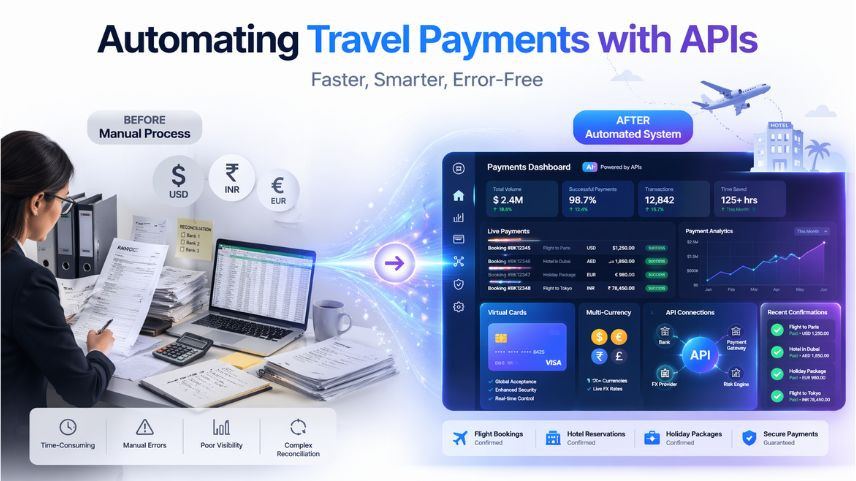
Still manually matching invoices and chasing payment failures? Your competitors are not.
In 2026, knowing how to automate payment APIs in travel agencies is a core operational requirement. Travel companies using automated payment workflows report 40 to 60 percent faster reconciliation and far fewer errors.
This guide covers everything you need: what payment API automation means, how to set it up step by step, which tools to use, and what mistakes to avoid.
API Integration
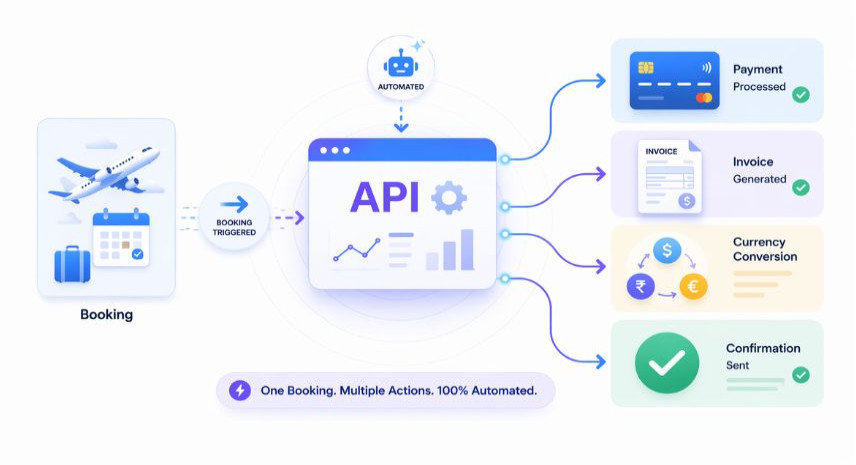
Payment API Automation Is A Process Where Travel Agencies Connect Their Booking Systems Directly To Payment Gateways, Banks, And Financial Platforms Without Any Manual Intervention. When A Booking Happens, Payment Is Automatically Collected, An Invoice Is Generated, Currencies Are Converted, And Records Are Reconciled In The Background.
In Short, Your Payment System Does The Heavy Lifting So Your Team Does Not Have To.
The Key Components Of A Travel Payment Automation Setup Include:
Many Travel Agencies And Tour Operators Are Still Doing This Manually In 2026:
The Cost Of Doing This Is Significant.
Human Error Is Constant. One Wrong Entry Can Throw Off An Entire Month Of Reconciliation. Slow Settlements Block Your Working Capital And Affect Cash Flow. Manual Processes Simply Do Not Scale. You Can Handle 100 Bookings Manually But Not 10,000. Compliance Gaps Arise Because Manual Workflows Rarely Produce Clean Audit Trails. And Your Best Finance People End Up Buried In Repetitive Grunt Work Instead Of Strategic Tasks.
In 2026, When AI-powered OTAs And Travel Platforms Are Processing Payments In Real Time, Manual Workflows Are Not Just Inefficient. They Are A Competitive Liability.
Here Is A Practical Roadmap You Can Actually Follow:
Your First Decision Is Selecting The Right Payment Gateway. Travel Agencies Have Specific Requirements That Generic E-commerce Gateways Often Do Not Meet Well.
Look For These Features:
Popular Options In 2026:
One Important Tip: Do Not Rely On A Single Payment Gateway. Setting Up A Dual-gateway Configuration Means That If One Provider Goes Down During Peak Booking Season, Your Second Gateway Automatically Handles The Traffic. This Redundancy Can Save You Thousands Of Dollars In Lost Bookings.
This Is One Of The Most Powerful And Underused Tools In Travel Payment Automation.
A Virtual Card API Allows You To Generate A Unique, Single-use Card For Each Supplier Payment You Make. Instead Of Sharing Your Corporate Card With Hundreds Of Hotels, Airlines, And DMCs, You Create A Disposable Virtual Card Loaded With The Exact Transaction Amount.
Here Is Why This Matters For Travel Agencies:
Top Virtual Card API Providers For Travel Companies In 2026:
A Mid-size OTA Dealing With 200 Or More Hotel Properties Can Realistically Cut Manual Payment Processing Time By 60 To 70 Percent Just By Adding A Virtual Card API To Their Workflow.
Travel Is A Global Business. Your Customers Pay In Different Currencies. Your Suppliers Invoice In Different Currencies. Your Profit Margins Depend On How Well You Handle The Gap Between The Two.
A Multi-currency Payment API Handles This Automatically. It Detects The Customer's Currency At Checkout, Applies Real-time Foreign Exchange Rates, Settles Funds In Your Base Currency, And Displays Conversion Charges Transparently.
Key Features To Look For:
Strong API Providers For Multi-currency Travel Payments Include Currencycloud (now Visa), Wise Business API, And OFX.
One Thing To Be Careful About: Avoid Any Provider That Updates FX Rates Less Frequently Than Every Few Minutes. Travel Margins Are Already Thin, And Forex Slippage On High-volume Transactions Eats Directly Into Your Profit.
Payment Reconciliation Is The Single Biggest Pain Point For Travel Agencies Operating At Scale. Manually Matching Booking IDs, Payment References, Supplier Invoices, And Bank Entries Is Essentially A Full-time Job.
Here Is How An Automated Reconciliation System Works:
Travel-friendly Reconciliation Tools In 2026:
According To Industry Benchmarks, Automated Reconciliation Reduces Daily Reconciliation Time From Four To Six Hours Down To Twenty To Thirty Minutes For A Typical Travel Agency Finance Team.
Manual Invoicing Is Another Major Time Sink. Here Is What A Properly Automated Invoicing Setup Should Do:
Useful APIs For Automated Invoicing In Travel:
Many Custom Travel Management Systems Integrate Directly With GDS Platforms Like Amadeus, Sabre, Or Travelport To Pull Booking Data Straight Into The Invoicing Workflow, Completely Eliminating Manual Data Entry.
PCI DSS Compliance Is Non-negotiable If You Accept Card Payments In Any Form.
First, Understand Which Compliance Level Applies To Your Business:
Practical Steps To Stay Compliant:
Modern Payment APIs Like Stripe, Adyen, And Razorpay Significantly Reduce Your PCI DSS Scope When You Use Their Hosted Payment Solutions. You Never Handle Raw Card Numbers, Which Means Your Compliance Burden Is Dramatically Lower.
For Large OTAs And Travel Management Companies:
For Mid-size Travel Agencies:
For Tour Operators And Destination Management Companies:
For Virtual Card Requirements Specifically, Conferma Pay, Nium, And Airplus International Are The Three Leading Choices.
A Complete Automated Payment Flow In A Modern Travel Agency Looks Like This:
A Customer Books A Trip. The Payment Gateway Charges The Card. A Webhook Triggers Booking Confirmation. A Virtual Card Is Generated And Used To Pay The Supplier. An Invoice Is Auto-generated And Emailed To The Customer. The Reconciliation System Matches The Payment, The Supplier Card Transaction, And The Booking Record. The Accounting System Is Updated Automatically.
This Entire Flow, Which Could Take Two To Three Hours Manually, Completes In Two To Three Seconds When Properly Automated.
The Key Integration Points In This Architecture Are:
Building This Kind Of Architecture Requires Deep Understanding Of Both Payment APIs And Travel-specific Workflows. If You Are Looking For The Right Technology Partner For This Journey, Working With An Experienced Travel API Integration Company In Delhi That Specializes In GDS Integrations, Payment APIs, And Travel Booking Systems Can Make The Difference Between A Project That Delivers Results And One That Stalls For Months.
Many Agencies Make These Mistakes When Setting Up Payment Automation. Here Is What To Watch Out For:
Relying On A Single Payment Gateway. If Your Only Gateway Goes Down During A Peak Booking Window, You Lose Revenue Directly. Always Build In A Fallback Gateway.
Ignoring FX Risk. Multi-currency Transactions Without Proper Forex Management Can Quietly Erode Your Margins, Especially On High-value Bookings With Significant USD/INR Or EUR/INR Exposure.
Skipping The Testing Environment. Never Deploy Payment Integrations Directly To Production. Test Thoroughly In A Sandbox Environment Covering Edge Cases Like Failed Payments, Partial Refunds, And Duplicate Transactions.
Not Handling Webhook Failures. If A Payment Succeeds But The Webhook Fails, Your Booking Confirmation Never Triggers. Always Implement Webhook Retry Logic And Set Up Monitoring Alerts.
Treating PCI DSS Compliance As An Afterthought. Retrofitting Compliance Into An Existing System Is Far More Expensive And Disruptive Than Building It In From The Start.
Having No Reconciliation Plan At Scale. Agencies Often Set Up Payment Acceptance Without A Clear Reconciliation Strategy. At Low Volumes This Is Manageable. At Scale It Becomes A Serious Operational Problem.
Creating Vendor Lock-in. Avoid Becoming So Dependent On One Provider That Switching Becomes Impossible. Build Your Payment Architecture On Open APIs With Clear Data Portability.
In 2026, Payment API Automation Is Not Just For Large OTAs. It Is A Practical Upgrade For Any Travel Agency Ready To Stop Doing Things Manually.
Start With The Right Payment Gateway, Add A Virtual Card API, Automate Reconciliation, And Build Compliance In From Day One.
Need Help Putting It All Together? A Specialized Travel API Integration Service Company can Connect Your Payment APIs, GDS Integrations, And Booking Workflows Into One Seamless System.
Get In Touch Today And Take The First Step.